
Flange Gaskets
ASME/ANSI rubber and aramid flange gaskets in every size and composition — from standard pipe flanges to custom assemblies.

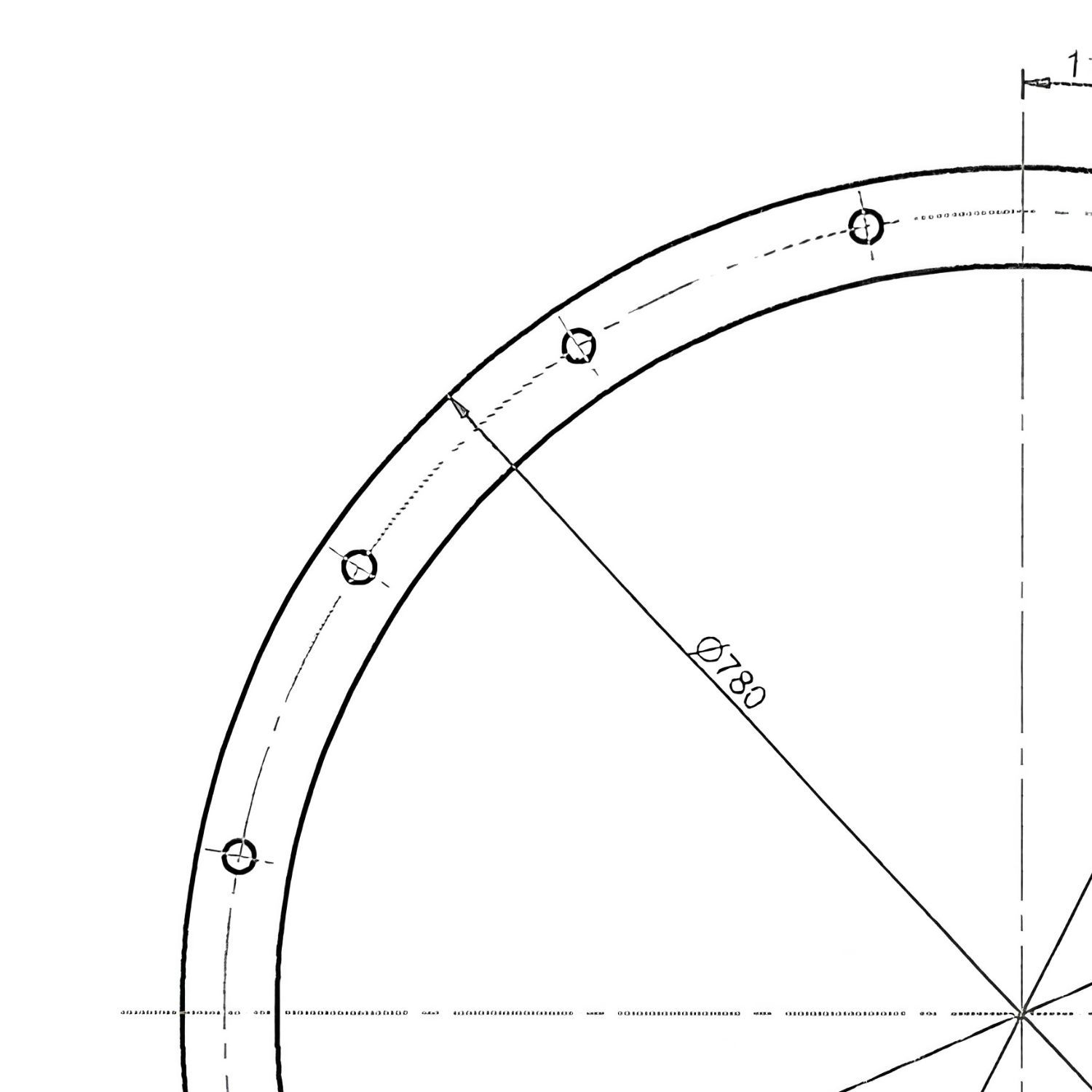
Overview
Essential sealing for flange assemblies
Flange gaskets are the workhorses of industrial piping — every flanged joint in petrochemical plants, water treatment facilities, power generation, and industrial plumbing relies on a gasket to maintain system integrity under operating pressure, temperature, and vibration.
ELASFOR specializes in ASME/ANSI compliant rubber and aramid fiber gaskets. The rubber component provides elasticity and conformability — allowing the gasket to fill microscopic surface irregularities on the flange face — while the aramid fiber reinforcement provides the structural strength needed to resist blowout under pressure and bolt load.
We supply rubber and aramid gaskets in every imaginable size and composition, with 100% inspection on critical sealing applications. Non-standard flanges, odd configurations, and urgent requests are handled regularly.
Measurement Guide
How to measure a flange gasket
Correct measurement is critical — a gasket that doesn't match the flange face geometry will not seal properly regardless of material quality. Use the measurement method that matches your gasket type.
Full face flange gaskets — ID, OD, and bolt holes
Full face gaskets cover the entire raised or flat flange face, including the bolt holes. They are used on flat-face flanges and cast iron flanges where the full surface contact distributes bolt load evenly.
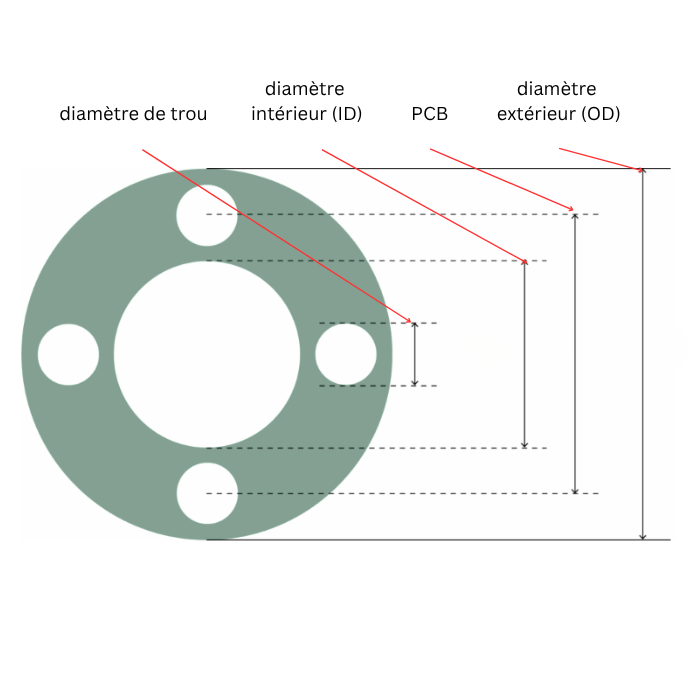
| Dimension | What to Measure | Notes |
|---|---|---|
| ID (Inner Diameter) | Bore diameter of the pipe — must match the pipe ID | Do not confuse with the flange bore, which may be slightly larger to accommodate weld bevels. |
| OD (Outer Diameter) | Overall gasket outer diameter — matches the flange OD | Full face gasket OD equals the flange OD including the bolt circle area. |
| PCD (Pitch Circle Diameter) | Circle diameter on which bolt holes are centered | Required to position bolt holes correctly. Measure from center to center of opposing bolts. |
| Bolt hole diameter | Bolt hole diameter in the gasket | Typically bolt nominal size + 3 mm clearance. Confirm from flange drawing or standard table (ASME B16.5). |
| Number of bolt holes | Count the bolt holes | Must match flange standard exactly. Rotational position of holes relative to split line must be confirmed. |
Ring-type gaskets — ID and OD only
Ring gaskets fit inside the bolt circle and contact only the raised face of the flange. No bolt holes — simpler to measure, easier to center.
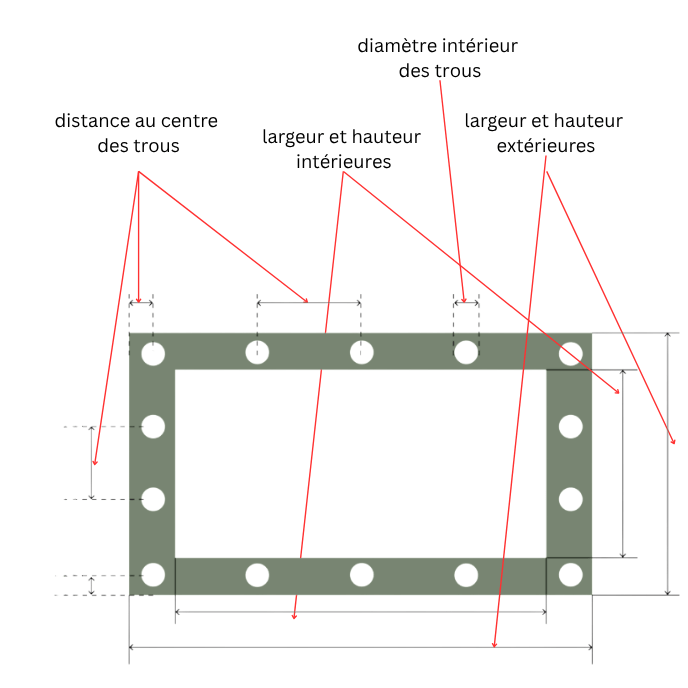
| Dimension | What to Measure |
|---|---|
| ID | Pipe bore diameter. The gasket ID must match or be slightly larger to avoid flow restriction. |
| OD | Must be smaller than the bolt circle diameter (PCD) to fit inside the bolts. Standard raised-face OD tables per ASME B16.20 and EN 1514-1. |
| Thickness | Measured uncompressed. Specify the compressed thickness you need if critical — compression depends on bolt load and gasket material. |
Gasket thickness — guidelines
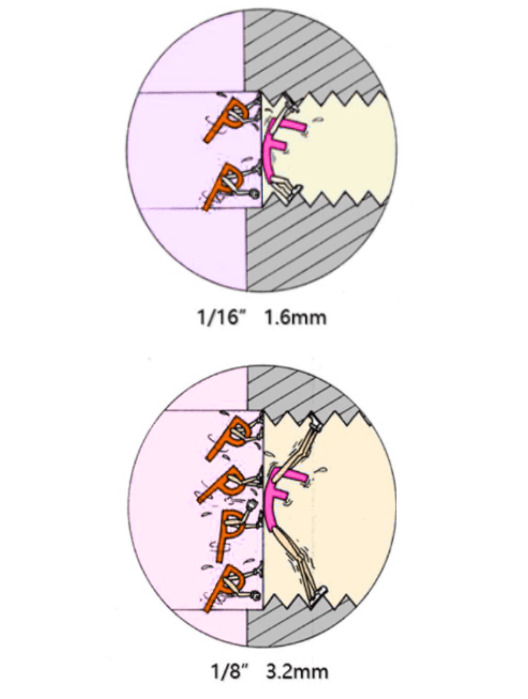
| Flange Condition | Recommended Thickness | Notes |
|---|---|---|
| New flanges, good surface finish | 1.5 mm | Minimum creep, maximum bolt load transfer. Preferred choice for new installations. |
| Standard industrial flanges | 3.0 mm | Most common specification. Accommodates minor surface irregularities. |
| Corroded, pitted or irregular faces | 4.5 mm or custom | Thicker gasket fills deeper surface defects. Consider face repair instead — a gasket is not a substitute for proper flange maintenance. |
Materials
Rubber and composite gasket materials
NBR / Aramid (Nitrile)
EPDM / Aramid
Neoprene (CR) / Aramid
FKM (Viton®) / Aramid
Silicone / Aramid
Flexible Graphite
PTFE / ePTFE
Full PTFE / Garlock GYLON
Need flange gaskets for your piping system?
Send us the flange standard, pipe size, fluid, pressure, and temperature — we'll specify the right material and supply to ASME, ANSI, or custom dimensions with 100% inspection.
Request a Quote