
PTFE Seals & Composites
When elastomer lip seals run out of chemical or thermal headroom — custom-made PTFE rotary seals for the conditions that destroy rubber.

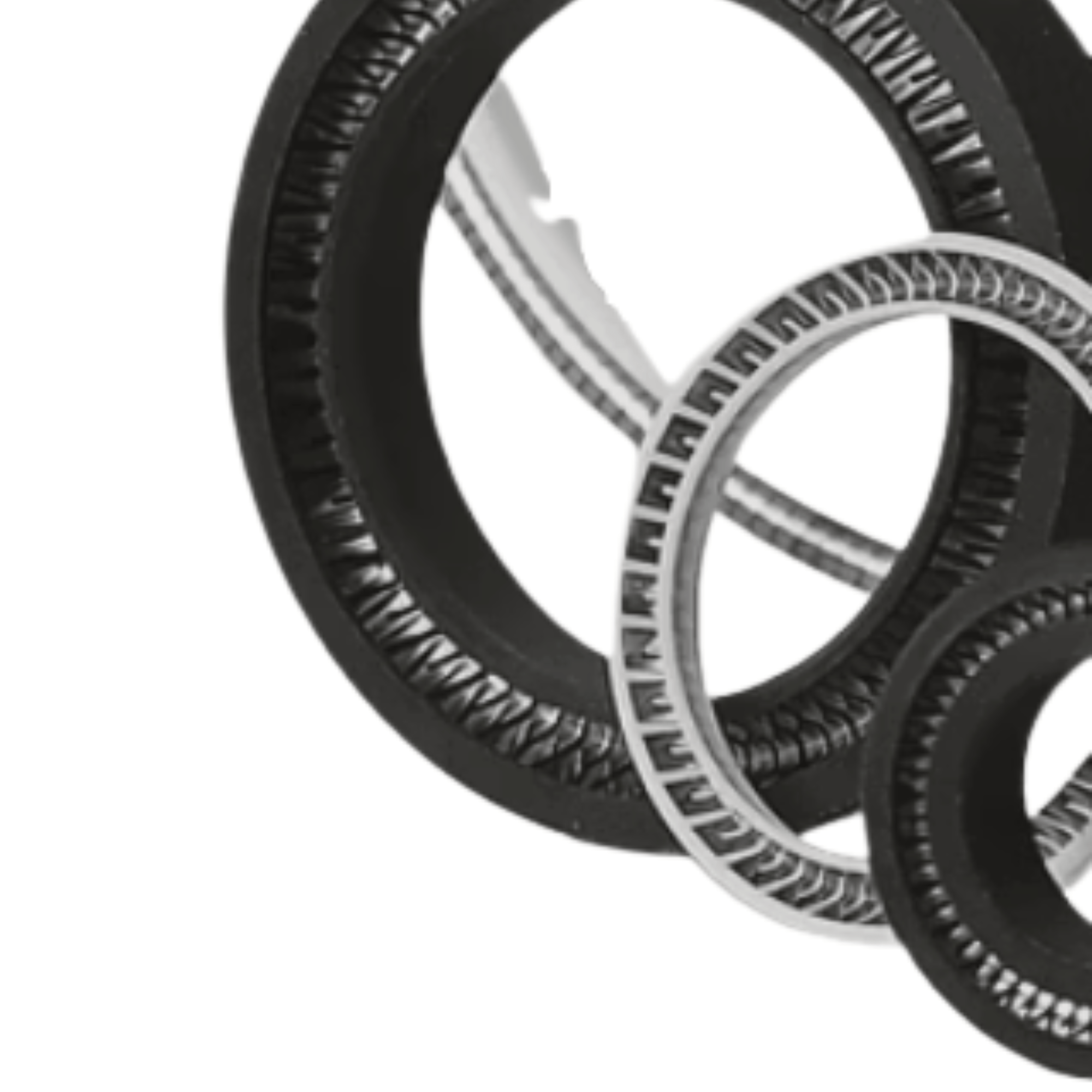
Overview
Custom-made PTFE seals for demanding dynamic applications
PTFE (polytetrafluoroethylene) seals are specified when operating conditions push beyond what elastomeric lip seals can sustain — temperatures approaching and exceeding 200°C, chemically aggressive media, or shaft speeds exceeding 20 m/s. They are widely used in aerospace, chemical and pharmaceutical processing, and high-speed rotating equipment.
Pure PTFE is chemically inert against virtually all industrial fluids. The tradeoff is mechanical: PTFE has high compression set, which means it does not spring back like rubber. All PTFE rotary seals require a spring element (typically a stainless or carbon steel garter spring) to maintain sealing lip contact over the seal's service life.
We supply custom-machined PTFE seals in all standard profiles and in the filler compounds listed below. If you're evaluating whether to upgrade from FKM to PTFE, the decision criteria below will help define the right call.
Design Reference
FKM vs. PTFE — when to upgrade
Upgrade triggers: when FKM is no longer the right answer
FKM remains the right seal for the majority of rotary applications. These are the conditions that justify the switch to PTFE:

| Condition | FKM Limit | PTFE Advantage |
|---|---|---|
| Temperature | Approaching 200°C continuous | PTFE composites run to 288°C (E81) or 315°C (E80) continuously |
| Chemical environment | Aggressive solvents, concentrated acids | PTFE resists virtually all industrial fluids — no swelling, no degradation |
| Shaft speed | >20 m/s becomes problematic | PTFE's lower coefficient of friction generates less heat at high speeds — extends seal and shaft life |
| Target service life | 800–1,200 hours in demanding conditions | PTFE designs routinely achieve 2,000+ hours in comparable service |
| Pressure / hydraulic pulsation | FKM lip deforms under high sustained pressure | PTFE with backup rings maintains geometry under pressure spikes |
| Energy efficiency | Higher friction torque | Lower friction = reduced drive power, measurable on high-cycle equipment |
PTFE limitations — what to account for in design
PTFE is not a drop-in replacement for an elastomeric lip seal. These design constraints must be addressed:
| Limitation | Design Response |
|---|---|
| High compression set — loses lip contact force over time | Garter spring is mandatory. Spring selection must account for operating temperature range. |
| Requires harder, smoother shaft surface | Shaft hardness minimum 45 HRC (vs. 30 HRC for elastomers). Surface finish Ra 0.2–0.4 µm. Harder and smoother than for rubber seals. |
| Fragile lip — easily distorted during installation or storage | Protective retaining rings are required during transport and storage. Installation tools must be used — never press directly on the seal lip. |
| No self-energizing effect from pressure | Sealing is entirely mechanical (spring-loaded). Verify spring load is sufficient for the operating pressure range. |
Material Specifications
PTFE filler compound selection guide
Filled PTFE composites were developed to address the mechanical weaknesses of virgin PTFE while preserving its chemical resistance. Filler selection is a balance between wear resistance, thermal conductivity, friction coefficient, and media compatibility.
| Code | Material | Color | Temp Range | Key Properties | Primary Applications |
|---|---|---|---|---|---|
| E71 | Virgin PTFE — unfilled | White | –254°C to +232°C | Maximum chemical inertness. Lowest friction. No filler that could contaminate media. | Cryogenics, pharmaceutical, food, low-pressure static seals |
| E73 | PTFE + 25% fiberglass | Grey | –130°C to +300°C | Significantly improved creep resistance and dimensional stability. Better load-bearing capacity. | Hydraulic cylinders, pneumatic actuators, moderate shaft loads |
| E74 | PTFE + glass + MoS₂ | Grey | –130°C to +300°C | Reduced wear, lower dry friction coefficient vs. E73. MoS₂ acts as a solid lubricant. | High-pressure applications, moderate shaft speeds, mixed lubrication |
| E75 | PTFE + graphite | Black | –155°C to +288°C | Self-lubricating, excellent dry-run behavior. Good thermal conductivity. | Chemical media, vacuum pumps, applications with intermittent lubrication |
| E76 | PTFE + carbon-graphite | Black | –155°C to +300°C | Improved thermal conductivity over E75. Better heat dissipation from sealing zone. | Valves, compressors, continuous-duty rotary applications |
| E77 | PTFE + carbon fiber | Black | –130°C to +288°C | High rigidity, excellent creep resistance, low wear rate. Strongest mechanical PTFE compound. | Shock absorbers, pumps, high dynamic load applications |
| E78 | PTFE + bronze | Brown/Bronze | –155°C to +260°C | High load capacity, good thermal conductivity, moderate speed. Not suitable for corrosive media (bronze content). | Rotary hydraulic seals, moderate-speed reciprocating applications |
| E79 | PTFE + mineral (FDA) | White | –155°C to +288°C | Inorganic filler, FDA compliant. Approved for direct food contact. | Food processing, pharmaceutical, beverage, medical devices |
| E80 | PTFE + stainless steel | Grey | –155°C to +315°C | Highest load bearing and thermal resistance of the PTFE series. SS filler compatible with corrosive media. | High-pressure static seals, extreme-temperature rotating equipment |
| E81 | PTFE + aromatic polyester | Beige | –155°C to +288°C | Exceptional wear and heat resistance. Excellent shaft compatibility — minimal shaft wear. | High-speed rotary seals, electric motors, compressors |
Material compatibility against specific fluids available on request. When in doubt on filler vs. media compatibility, E71 (virgin PTFE) is the chemically safest choice — upgrade to filled grade only for the mechanical benefit needed.
Need a PTFE seal for your application?
Send us the shaft diameter, speed, operating temperature, and the fluid — we'll specify the right compound and profile, and produce it to your exact dimensions.
Request a Quote