
Spiral-Wound Gaskets
When rubber gaskets run out of runway — metal-reinforced joints for extreme pressure and temperature.
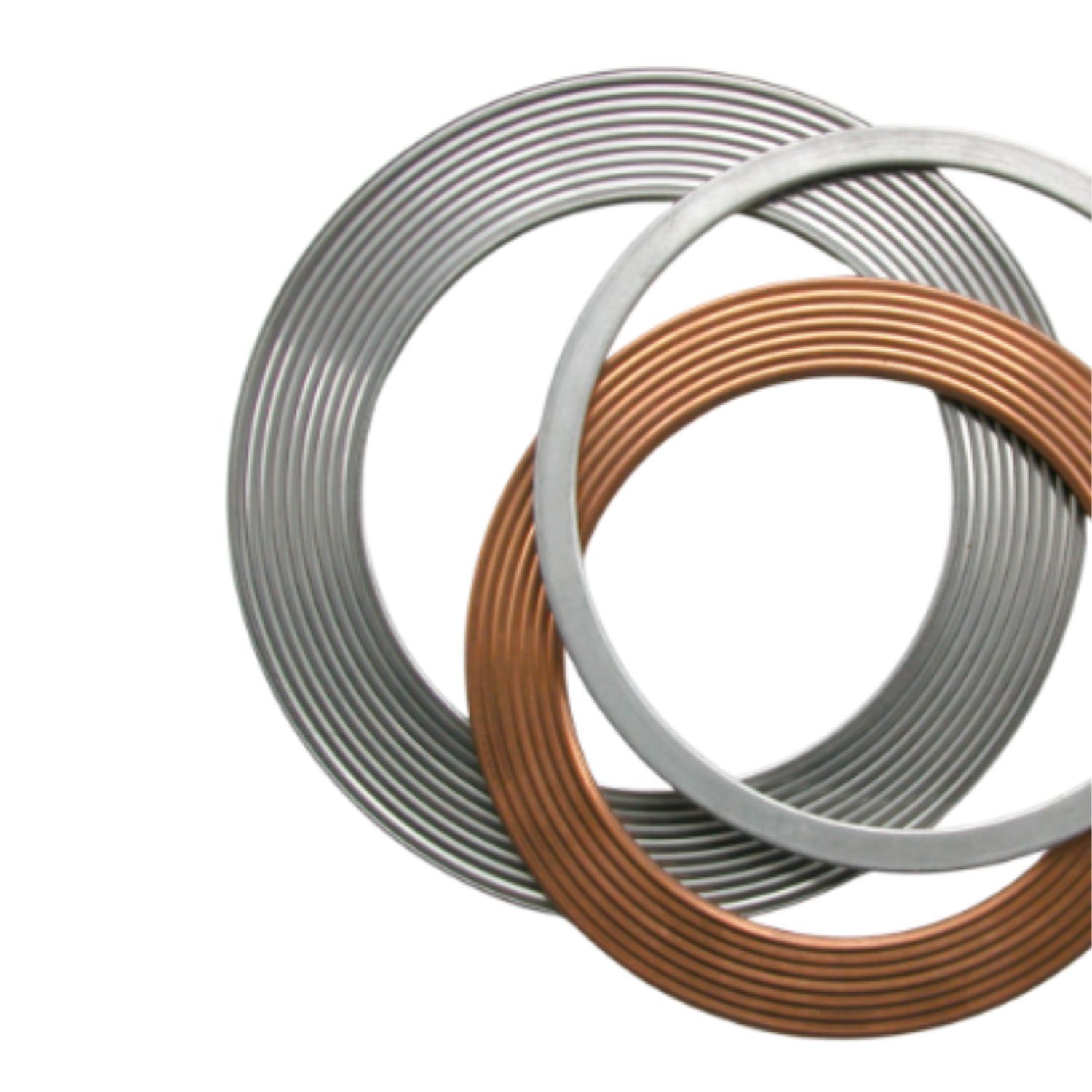

Overview
Robustness and reliability in extreme environments
Spiral-wound and metal gaskets are the preferred sealing solutions when temperature, pressure, or chemical conditions exceed what sheet and rubber gaskets can handle. Nuclear power plants, petrochemical refineries, hydroelectric installations, and aeronautical systems all rely on metal-reinforced gaskets because there is simply no substitute when failure means a fire, a spill, or a shutdown.
The defining characteristic is the combination of a metal structural element — wound strip, corrugated core, or solid ring — with a softer filler (PTFE, graphite, mica) that deforms under bolt load to conform to flange surface irregularities. The result is a seal that can cycle through extreme temperatures repeatedly without losing its seating stress.
At ELASFOR we supply all five main metal gasket types to ASME B16.20, EN 1514-2, and API 6A standards. If your application calls for a non-standard OD, exotic alloy, or a specific combination of ring and filler, contact us with your flange specs and we'll source it.
Product Types
Five metal gasket configurations
Each construction addresses a different combination of pressure, temperature, surface finish, and cycling requirements. Select based on your flange class and service conditions — not interchangeable.

Standard Spiral-Wound
Alternating metal strip and graphite/PTFE filler. Inner + outer centering rings. ASME B16.20. Petrochemical, power generation.

Corrugated Metal
Corrugated metal support laminated with graphite or PTFE facing. Steam flanges, heat exchangers, moderate cycling.

Expanded Graphite
Pure flexible graphite, optionally with steel insert. Excellent thermal and chemical resistance. Pumps, valves, exchangers.

Metal Ring (RTJ)
Solid alloy steel ring — oval or octagonal profile. API 6A and ASME B16.20. Pressures exceeding 1,000 bar. Wellheads and offshore.

Kammprofile
Solid metal core with concentric serrated grooves, covered with graphite or PTFE. Handles irregular surfaces and severe thermal cycling.
Design Reference
Selection & installation parameters
Spiral-wound — bolt load and compression limits
Spiral-wound gaskets require a minimum seating stress to achieve initial seal, and a maximum stress that must not be exceeded or the gasket will over-compress and lose spring-back. Both values depend on gasket size and filler type.
| Parameter | Typical Range | Notes |
|---|---|---|
| Min. seating stress (m) | 10,000 psi (69 MPa) | Minimum bolt load to achieve initial seal. Below this, the filler does not conform to surface irregularities. |
| Max. seating stress | 45,000–65,000 psi depending on size | Exceeding this crushes the winding permanently. Over-torquing is the most common installation error. |
| Operating temperature | Graphite filler: –200°C to +540°C; PTFE filler: –200°C to +260°C | Graphite is preferred above 260°C. PTFE is preferred for strong oxidizers and acids. |
| Flange surface finish | 125–250 µin Ra (serrated phonographic finish) | Too smooth and the filler won't anchor. Too rough and the metal strips bridge over peaks without sealing. |
| Outer ring (centering) | Mandatory for raised-face flanges | Prevents over-compression by acting as a hard stop. Never remove the outer ring to fit a non-standard bore. |
Metal ring gaskets (RTJ) — groove and hardness matching
RTJ gaskets seal by plastic deformation of the ring against the groove walls. This requires the ring to be softer than the groove material — always verify hardness before ordering replacement rings, especially after repairs.
| Ring Alloy | Max. Hardness (BHN) | Typical Service |
|---|---|---|
| Soft iron | 90 | Low-alloy carbon steel flanges, water service |
| Low-carbon steel | 120 | Standard process flanges |
| 304 / 316 SS | 160 | Corrosive media, moderate temperature |
| Alloy 825 | 159 | Sour gas (H₂S), high chloride environments |
| Inconel 625 | 200 | High-temperature, high-pressure, oxidizing service |
RTJ ring grooves may only be re-used a limited number of times before groove damage prevents proper sealing. Inspect groove walls for plastic deformation before re-installation.
Filler material compatibility — quick reference
| Filler | Max. Temp | Avoid With | Best For |
|---|---|---|---|
| Flexible graphite | 540°C | Strong oxidizers (fuming HNO₃, O₂ above 450°C) | Steam, hydrocarbons, general process |
| PTFE | 260°C | Molten alkali metals, elemental fluorine | Acids, caustics, chlorinated solvents |
| Mica | 900°C | HF, strong acids | Extreme high-temp (furnaces, incinerators) |
| Ceramic fiber | 1000°C+ | Wet environments (hygroscopic) | Furnace doors, thermal cycling at extreme temps |
Metal Construction
Winding and ring alloys
The metal component carries the structural load and controls compression. Alloy selection is driven by temperature, corrosion resistance, and compatibility with the flange material — galvanic coupling must be considered.
304 Stainless Steel
316 Stainless Steel
Alloy 825 (Incoloy)
Inconel 625
Carbon Steel
Copper
Titanium
Hastelloy C-276
Need a metal gasket for your flanged joint?
Give us the flange class, pipe size, and service conditions — we'll identify the right gasket type, alloy, and filler, and source it to ASME, API, or EN spec.
Request a Quote